January 7th, 2024, I was admitted to our local hospital. The first day involved educating the on-call doctors and nurses about the symptoms and issues I had experienced over the past several weeks. Fortunately, my pastor rushed to my bedside shortly after her Sunday service, which my wife and I had watched on her phone while waiting for my room. Our pastor quickly offered a prayer and rallied our church family behind us. She was ready to assist in any way necessary and importantly, she provided the reassurance my wife needed, saying, “Don’t be afraid to advocate for him and follow your instincts.” Knowing this hospital well and having seen many parishioners face illnesses, she adeptly guided my wife on how to navigate the hospital setting. It was our pastor’s encouraging words and, no doubt, divine inspiration that gave my wife the courage and the ‘light bulb’ moment to decisively push for my transfer to the Hospital of the University of Pennsylvania (HUP). At CHOP, HUP’s sister hospital for children, our pastor’s granddaughter had been treated for a life-threatening illness at a very young age and now frolics carefree around the church with our son. It was at HUP where our pastor’s husband was recently successfully treated for cancer. Aware of the severity of my condition and without knowing the exact diagnosis, she gave my wife permission to trust her own instincts.
Tuesday, January 9th was the day my wife arrived at the hospital armed with God’s strength and a clear mission. (See Cancer Journey Part 3) It was also the day that I was worried I was going to die at this hospital where no one seemed to be giving me any sort of attention let alone urgent attention. I was deteriorating so fast. The day before, on Monday, I had a bone marrow biopsy which was surreal. I felt as if I was almost dead, but I remember hearing a drill sound as someone was digging into my hip. Monday night I was so poorly cared for by a nurse that I was afraid to be there another night. Now it was Tuesday morning and the hospitalist thought I was fine and was willing to wait one to two weeks for test results before starting any kind of treatment.
Tuesday, January 9th was the day my life was saved. I was transferred to HUP at the highest level of priority. I still don’t even know what that means, but that’s what the nurse practitioner said and that is how I felt once I arrived there.
The tricky part was getting to HUP. By now it was about 6pm with the transport vehicle on its way, but there was a horrible storm outside. There were high winds and heavy rain happening with possible flash flooding. The weather alert on my phone clearly warned everyone in our area to stay inside, don’t drive and watch out for the floods. It was going to be another fun drive [sarcasm].
My wife was quickly making calls to family and warning my mother-in-law that she would be needed at our house for the foreseeable future. As my wife packed up my room, she made sure to tell the nurse that I needed something to prevent motion sickness. I sometimes get motion sickness and I was about to get into the back of an ambulance during a monsoon. To make matters worse, if I were to vomit, my tongue and swallow muscles were not working and aspiration was possible.
The two guys driving the ambulance were rough around the edges. I could hear the worry in my wife’s voice while she was quickly trying to explain to them my severe pain, and that my speech was impaired. Again her biggest worry was my inability to clear any vomit from my throat if I were to get sick during the hour long drive. All of this was happening right as the nurses were changing shifts. The day nurse had handed me a packet of records that I was to hand off to the staff at HUP when I arrived. There I was, being put on a stretcher by two guys who looked more like auto mechanics rather than EMT/ambulance drivers while my wife was playing nurse trying to get them up speed on my condition. These guys didn’t really treat me like a sentient human and the vibe was more like, “wow this guy is really messed up and we need to take him somewhere else.” At least they were kind enough to give me a shot of anti-nausea medication as the journey began.
As I lay in the back of the ambulance with the one mechanic, I clutched my phone staring at Google maps counting down the minutes until our arrival. It was not fun getting bounced around in the back during the storm. It smelled like a car mechanic’s shop and I was thinking, “do these guys fix race cars as a side hustle?”
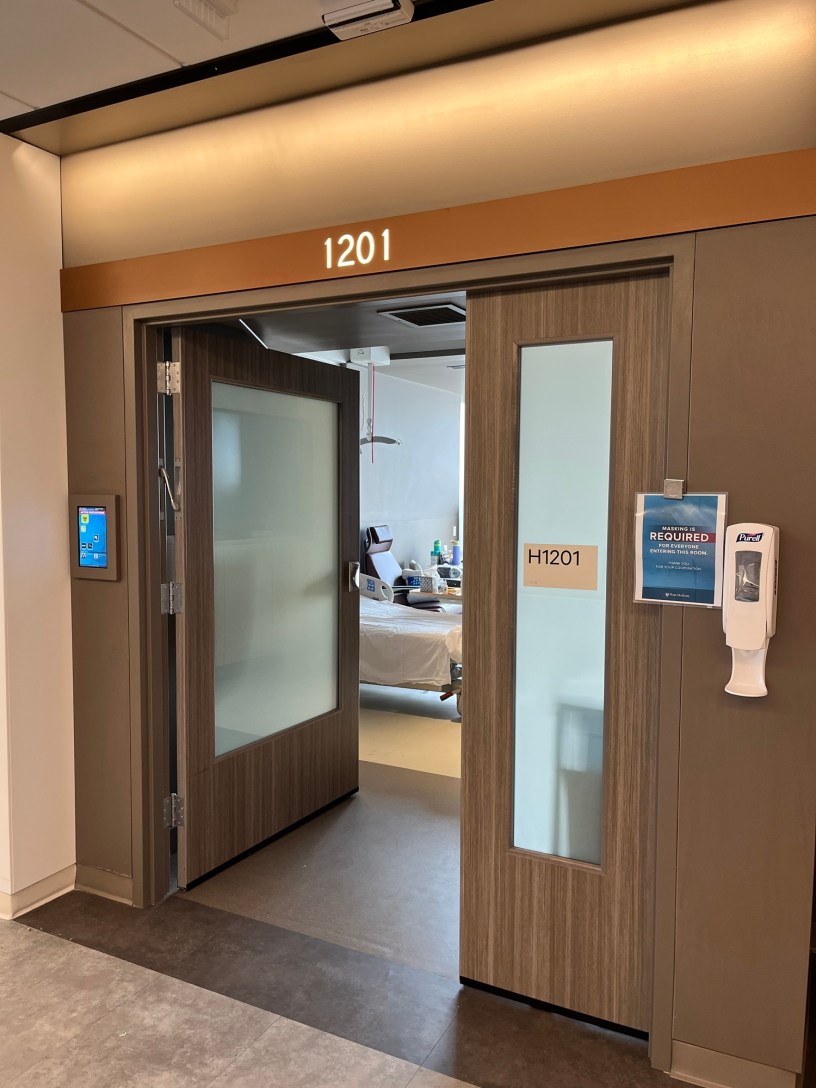
When I arrived at HUP I was taken directly to a back door in the parking garage. I had no idea where I was, but going through a door in a parking garage seemed very odd to me. At this point, my memory is very little. I don’t remember the elevator ride up to the 12th floor or getting into my room. I vaguely remember my wife finally arriving after what felt like forever, but was probably only 15 or 20 minutes later.
I was now in a very beautiful facility, and my room was nicer than most hotels. According to my wife, I had a team of people in my room at 9pm on a Tuesday. I vaguely recall having a sense of relief as I knew I was in great hands.
From this point on, my memory of the following 3 weeks is a little choppy. I’ve discussed with my wife the events of those days and even for her, things are blurry. It was a surreal time in our lives. Days went by, weeks went by, but for us it was like one endless day and we both lost track of time.
The evening of January 9th around 9pm, I was admitted to the Hospital of the University of Pennsylvania under the care of the leukemia team. My previous blood work showed that I was anemic. My MRI’s had shown abnormality in my bone marrow. Because I had no tumors showing in MRI scans, it was assumed that I had a blood cancer. Armed only with some data from initial tests and clinical reports, HUP knew to put me on the cancer floor. And they made a quick guess that it was leukemia: there was no wait-and-see approach here. According to my wife, I had at least four eager residents and fellows in my room for almost the entire first night. They were each devouring the packet of records I had brought along with me as well as collecting all the tests and records from the previous hospital and doctors offices I had visited. Whatever they couldn’t retrieve or didn’t have access to wasn’t a concern. They were moving forward anyway. They were not waiting.
My wife stayed up the entire night and helped the team navigate through my history and symptoms. She has said that she lost count of how many people entered my room. Again, this was between the hours of 9pm and 9am. I was certainly the highest priority. I have no memory of this night at all and my wife filled me in on the details at some point later.
As I was examined by the leukemia team, the neurology team and countless other specialists, more of my prior tests were being read and analyzed. By 9am an oncologist from the lymphoma team entered my room and told me that he would be taking over my care. It had become apparent that I did not have leukemia, but had some type of Large B Cell lymphoma instead. He was unsure yet exactly what type I had, but assured me that he was going to start treatment immediately. “It doesn’t really matter at this point what type you have. The treatment is about the same and I want to start you on a treatment that would be used no matter what type of lymphoma you have. I also want to do another spinal tap so we can get a sample of your spinal fluid and while we are in there, we will give you Methotrexate in your spine.” Again this was all a bit of a blur to me, but I would later find out (much later, like after my 4th round of chemo) that one of the doctors had initially told my wife that the cancer was likely in my spine and brain because of the symptoms I was having. I’m glad nobody told me that because it would have crushed my spirit to do what it takes to get better. The good news is that after my 2nd spinal tap came back negative, it was determined that the cancer had not spread to my spine or my brain. My outcome could have been much different if it had.
Within 12 hours of being at HUP, I was already being treated. I had a corticosteroid running through an IV and Methotrexate injected into my spine. The Methotrexate is used in case lymphoma cells were in my spine and central nervous system (CNS), but hadn’t been detected. It also serves as a preventative measure and therefore is part of the treatment regimen for each subsequent round of chemo.
By 1pm on Wednesday January 10th, I was already feeling a bit better. My pain had slightly diminished from the steroids, but my speech was at its worst and I didn’t have anything to eat or drink in over 24 hours. I was still being evaluated by several teams including speech therapy, nutrition, and mostly the neurology team. My neuropathy symptoms were so similar to having a stroke; extremely slurred speech, numbness on one side of the body, and unable to walk or eat. Neurology was being super cautious before releasing me to the complete care of the oncology team. After a brief visit from the stroke team (of about eight people in my room), they quickly they realized the lymphoma was likely doing nerve damage and I didn’t have a stroke.
HUP was doing their best to get details of my outside bone marrow biopsy, but for whatever reason, it seemed to take forever. As each new piece of information came in, I was updated and my treatment plan became more apparent. By Thursday, January 11th, my oncologist said he was between two different types of lymphoma for my diagnosis. The first option being Diffuse Large B Cell lymphoma and the other option being Burkitt’s lymphoma. They both look similar in pathology and since my biopsy wasn’t the best sample, it was hard to determine exactly. They would have to look at more clinical symptoms to determine my precise treatment plan. The doctor said he would have an answer for me by Friday.
By Friday, January 12th the team had determined that I likely had Burkitt’s lymphoma. “I’m 99% sure it’s Burkitt’s. Could it still be DLCL? Yes, but that wouldn’t change the treatment plan too much. So I’m going to start you on R-EPOCH today. I think you’ll respond quickly and we will go from there.”
Finally I received a diagnosis. At 5pm on Friday, January 12th, 2024 I started my first round of chemotherapy for Burkitt’s lymphoma. The aggressive treatment would last for 5 days straight. A continuous drip of IV chemo with each bag lasting 24 hours. At some point they inserted a PICC line into my arm so I would no longer need needle sticks. The chemo, medications and IV fluids were administered via the PICC. I was informed that the standard treatment protocol would be six rounds of chemo spread out over several months.
The days all ran together. I was at HUP from the evening of January 9th through the afternoon of January 27th. The first few days were intense. Countless tests, blood draws, examinations and meeting so many doctors, fellows and students.
Once the chemo and additional steroids started, my pain quickly subsided, and soon was at a level zero. Such beautiful relief. I had been in excruciating pain for over a month and finally it stopped. Now it was time to pray for my many other symptoms to reverse.
Take away: Unfortunately, not all hospitals or doctors provide equally great care.
———————————
Continue reading ‘Part 5:’ https://vincepaton.com/2024/04/24/cancer-journey-part-5-chemo-round-one/
————————————————
Get notified when a new post is published. Subscribe here: https://vincepaton.com/about/
 Vince Paton's Blog